Naratriptan
AMERGE
Pronunciation: NAR-a-trip-tan (a-MERJ)
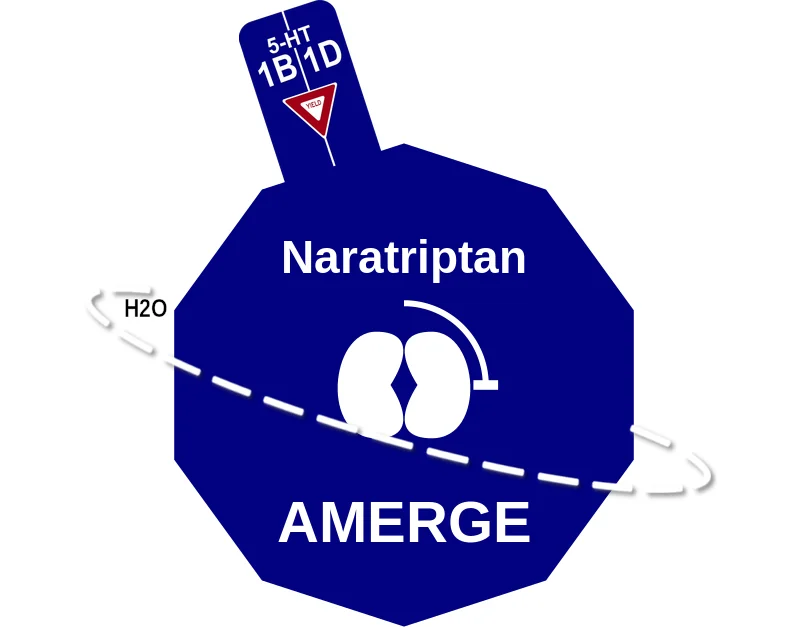
What it is5-HT1B/1D agonist; acute migraine.
Why this oneIts slower onset and longer action produce fewer recurrences, fitting gradual or prolonged attacks.
What limits itIt is too slow for a fast-peaking attack. Coronary vasospasm precludes use in ischemic disease; adjust for renal impairment.
FDA-approved for
- migraine (1998)
FDA label
Read the full label on DailyMed ↗
| FDA dosing | Population | Start | Target | Max |
|---|---|---|---|---|
| Acute migraine | Adults | 1 mg or 2.5 mg PRN | 1 mg or 2.5 mg | 5 mg / 24 h |
Renal Mild-moderate: start 1 mg, max 2.5 mg/24 h; contraindicated in severe (CLcr <15 mL/min)
Hepatic Mild-moderate (Child-Pugh A/B): start 1 mg, max 2.5 mg/24 h; contraindicated in severe (Child-Pugh C)
May repeat once after 4 h; not to exceed 5 mg in any 24-h period
Instructions
- May repeat once after 4 h if migraine returns or partial response
- Safety of treating >4 migraines per 30 days not established
Available strengths
- tab 1, 2.5 mg
Contraindications
- Ischemic coronary artery disease or coronary vasospasm (incl. Prinzmetal's angina)
- Wolff-Parkinson-White syndrome or arrhythmias with accessory conduction pathways
- History of stroke/TIA, or hemiplegic or basilar migraine
- Peripheral vascular disease
- Ischemic bowel disease
- Uncontrolled hypertension
- Recent (within 24 h) use of another 5-HT1 agonist or ergotamine/ergot-type medication
- Severe renal or hepatic impairment
Cautions
- Myocardial ischemia/infarction and Prinzmetal's angina
- Arrhythmias
- Chest/throat/neck/jaw pressure (usually non-cardiac)
- Cerebrovascular events (hemorrhage, stroke)
- Other vasospasm (peripheral, GI ischemia, Raynaud's)
- Medication overuse headache
- MAOIs due to risk of serotonin syndrome
- Blood pressure elevation
Adverse reactions
- Paresthesias
- Nausea
- Dizziness
- Drowsiness
- Malaise/fatigue
- Throat/neck symptoms
Pregnancy No adequate human data; animal developmental toxicity (embryolethality, fetal abnormalities)
Lactation No human data; present in rat milk
Cost
Generic entry2010
NO BOXED WARNINGS
Principal riskSlow onset; coronary vasospasm
Classes and tags
Clinical profile
Legacy pregnancy categoryUnknown / historical label unavailable
Defining liabilityAgent-specific vascular, serotonergic or hepatic risks; acute overdose is usually limited outside ergot or cardiovascular agents.
Serotonicity
This drug is routinely called serotonergic. By Gillman’s human-effect criteria it does not raise serotonin in the synapse.
Triptan receptor agonism is not a mechanistic serotonin-toxicity interaction with SRIs.
Gillman’s four human testsA measurable SERT affinity that fails all four is not clinical serotonicity.
- Retarded orgasm
- Efficacy in OCD and cataplexy
- Clonus and hyperreflexia in single-drug overdose
- Serotonin toxicity when combined with an MAOI
Non-elevating action5-HT1B/1D agonist
Evidence confidenceHigh
Background: what serotonicity is · what is and is not an SRI · what counts as a relevant MAOI.