Lithium
lithium carbonate
Pronunciation: LITH-ee-um
“Lithium ion (battery)”
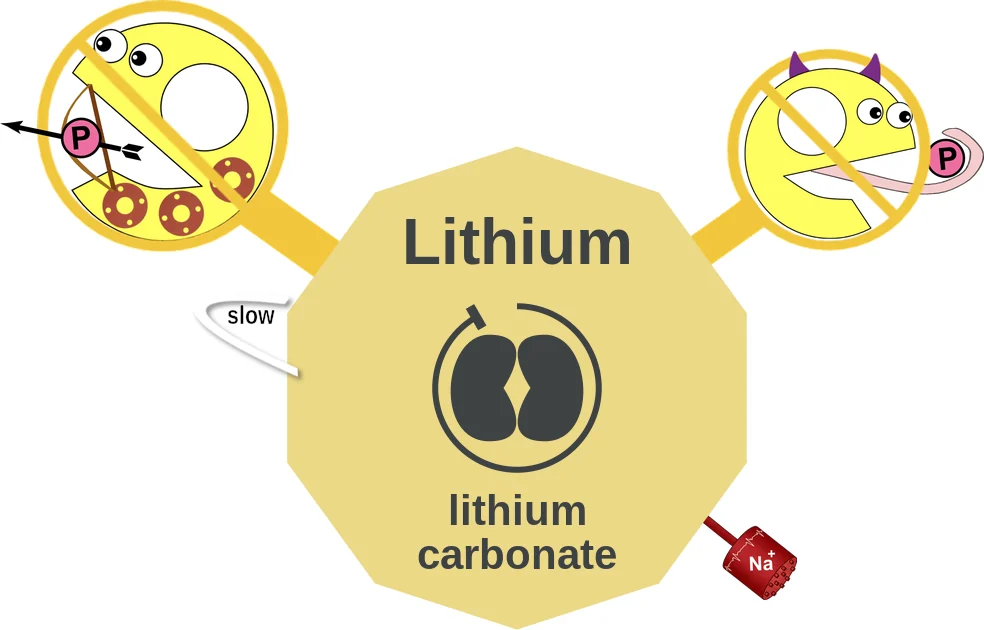
What it isMood stabilizer inhibiting GSK-3beta and inositol monophosphatase; bipolar maintenance and depression augmentation.
Why this oneThe only agent with consistent evidence for reducing suicide in bipolar disorder.
What limits itNarrow therapeutic index with level monitoring. Renally cleared, so NSAIDs, thiazides and ACE inhibitors raise levels. Monitor thyroid and renal function.
FDA-approved for
- bipolar mania (1970)
Off-label
- antidepressant augmentation
- suicide-risk reduction
- cluster headache
FDA label
Read the full label on DailyMed ↗
| FDA dosing | Population | Start | Target | Max |
|---|---|---|---|---|
| Bipolar I, acute manic/mixed | Adults & peds >30 kg (≥7 yr) | 300 mg TID | 600 mg BID–TID; serum 0.8–1.2 mEq/L | |
| Bipolar I, maintenance | Adults & peds >30 kg (≥7 yr) | 300–600 mg BID–TID; serum 0.8–1.0 mEq/L | ||
| Bipolar I, acute manic/mixed | Peds 20–30 kg | 300 mg BID | 600–1500 mg/day divided | |
| Bipolar I, maintenance | Peds 20–30 kg | 600–1200 mg/day divided |
Titration Increase by 300 mg every 3 days (weekly in peds 20–30 kg)
Renal CLcr 30–89 mL/min: start below normal dose, titrate slowly; CLcr <30 mL/min: avoid
Hepatic Undefined
Narrow therapeutic index; toxicity (≥1.5 mEq/L) close to therapeutic range (0.8–1.2 mEq/L)
Instructions
- Take with food to reduce GI upset
- Draw serum lithium 12 hr post-dose after 3 days and regularly until stable
- Decrease or discontinue 2–3 days before expected delivery
Available strengths
- cap 150, 300, 600 mg
- tab 300 mg
- ER tab 300, 450 mg
Cautions
- Lithium toxicity
- Lithium-induced polyuria / nephrogenic diabetes insipidus
- Hyponatremia (dehydration raises toxicity risk)
- Chronic kidney disease with long-term use
- Encephalopathic syndrome with antipsychotics
- MAOIs due to risk of serotonin syndrome
- Hypothyroidism or hyperthyroidism
- Hypercalcemia / hyperparathyroidism
- Unmasking of Brugada syndrome
Adverse reactions
- Fine hand tremor
- Polyuria
- Thirst
- Nausea
- General discomfort during initial treatment
- Peds: nausea/vomiting, thyroid abnormalities, ataxia/gait disturbance, dizziness
Pregnancy May cause fetal harm (cardiac malformations incl. Ebstein's anomaly with 1st-trimester use); neonatal/floppy-baby toxicity with late-pregnancy use
Lactation Present in human milk; breastfeeding not recommended — monitor infant for toxicity if breastfed
Cost
| Strength | #/mo | generic $/mo | CostPlus | |
|---|---|---|---|---|
| 150 mg | cap | 90 TID | $8.67 | offered |
| 300 mg | cap | 90 TID | $9.35 | offered |
| 600 mg | cap | 90 TID | $21.83 | offered |
Other forms: Lithium ER (LITHOBID)
Generic entry1986
⚠ BOXED WARNING
- Lithium toxicity is closely related to serum concentration and can occur at doses close to therapeutic levels
Classes and tags
Clinical profile
Legacy pregnancy categoryD
Defining liabilityNarrow therapeutic index; nephrogenic diabetes insipidus
Serotonicity
This drug is routinely called serotonergic. By Gillman’s human-effect criteria it does not raise serotonin in the synapse.
May modulate serotonin signaling but is not a significant SRI and is not a severe-ST trigger by Gillman's criteria.
Gillman’s four human testsA measurable SERT affinity that fails all four is not clinical serotonicity.
- Retarded orgasm
- Efficacy in OCD and cataplexy
- Clonus and hyperreflexia in single-drug overdose
- Serotonin toxicity when combined with an MAOI
Non-elevating actionNone recorded
Evidence confidenceHigh
Background: what serotonicity is · what is and is not an SRI · what counts as a relevant MAOI.
Pharmacodynamic cautions (no lithium level change)
Excluded from the AUC CHANGE ESTIMATOR because they do not change lithium levels; they matter clinically for toxicity risk.
- Osmotic diuretics — Renal-marker study only — not a therapeutic-dose interaction. increased lithium excretion via osmotic diuresis
- Caffeine — Renal-marker study only — not a therapeutic-dose interaction. increased renal lithium clearance
- Carbamazepine — ⚠ neurotoxicity risk (no level change). FDA label: neurotoxicity risk; no PK effect demonstrated.
- Verapamil — ⚠ neurotoxicity risk (levels variable). Case reports: neurotoxicity; lithium levels ↑/↓/unchanged. No controlled PK study.
- Diltiazem — ⚠ neurotoxicity risk (case report). Single case report of possible neurotoxic interaction.
- Fluvoxamine — ⚠ serotonergic risk (no level change). Serotonergic (pharmacodynamic) interaction; no effect on lithium levels.
- Triamterene — Renal-marker study only — not a therapeutic-dose interaction. distal tubular sodium/lithium handling; increased fractional lithium excretion