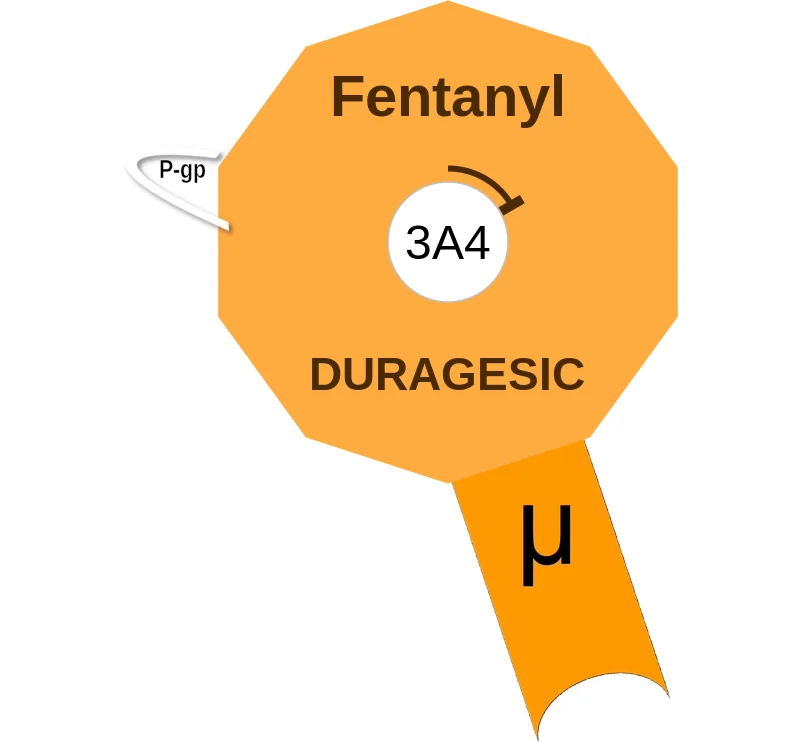
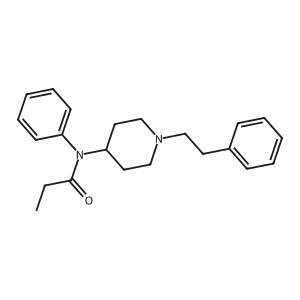
Fentanyl
DURAGESIC
Pronunciation: FEN-ta-nil (dur-a-JEE-zik)

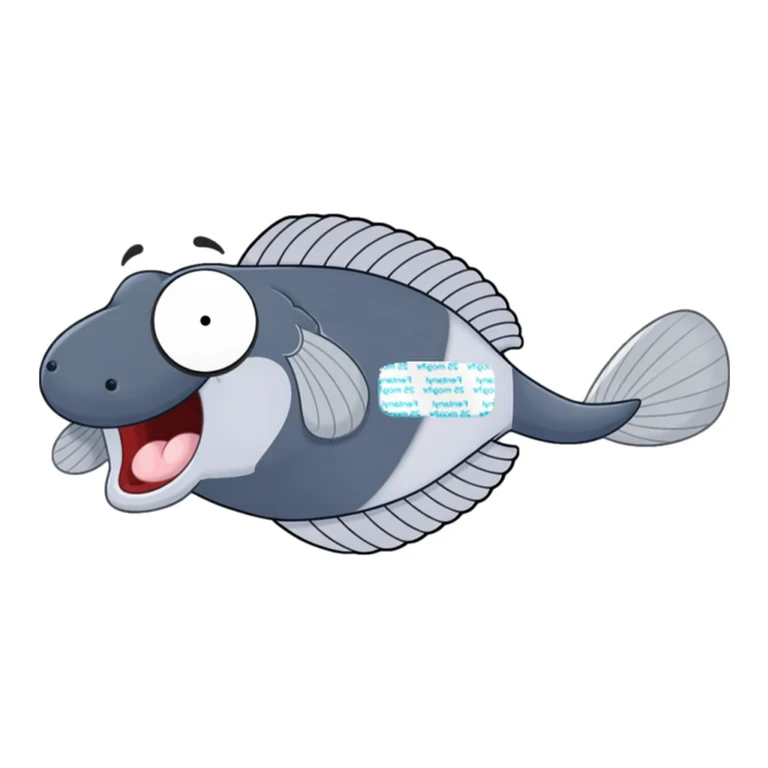
“Fountain eel’s Durable analgesic”
pinpoint pupils → opioid
Used patches are to be flushed down the toilet
What it isHigh-potency lipophilic mu agonist; severe pain, anesthesia and transdermal chronic pain.
Why this oneNo active metabolites, so it is the opioid of choice in renal failure, and its lipophilicity allows patch and mucosal delivery.
What limits itThe patch takes 12 to 24 hours to work and is only for opioid-tolerant patients; heat raises absorption. Potency makes dosing errors lethal.
FDA-approved for
- pain (1968)
FDA label
Read the full label on DailyMed ↗
| FDA dosing | Population | Start | Target | Max |
|---|---|---|---|---|
| Severe, persistent pain requiring an opioid, inadequately treated by alternatives — opioid-tolerant patients only | Adults (opioid-tolerant) | By conversion table (e.g., oral morphine 60–134 mg/day → 25 mcg/h), one patch q72h | Individually titrated; one patch q72h (q48h only if 72-h regimen fails after dose increase) | Undefined (>100 mcg/h: use multiple systems) |
| Severe, persistent pain — opioid-tolerant | Peds ≥2 y (opioid-tolerant) | By oral-morphine conversion table, one patch q72h | Individually titrated; q72h only | Undefined |
Titration First increase no sooner than 3 days after initial application; thereafter wait at least two 3-day applications before each further increase.
Renal Mild–moderate: start at one-half the usual dose, titrate slowly, monitor for respiratory/CNS depression; severe: avoid.
Hepatic Mild–moderate: start at one-half the usual dose, titrate slowly, monitor for respiratory/CNS depression; severe: avoid.
Conversion tables are conservative and must not be used to convert from fentanyl patch to other opioids. Dose increments: 12 mcg/h per 45 mg/24 h supplemental oral morphine. Intermediate 37.5 and 62.5 mcg/h strengths available.
Instructions
- Opioid-tolerant only; discontinue or taper other extended-release opioids when starting. Never first opioid.
- Apply to intact, non-irritated, non-irradiated flat skin (chest, back, flank, upper arm; upper back in young children); clip hair, clean with water only.
- Do not cut or alter; press firmly with palm for 30 seconds; wear 72 h, then apply new patch to a different site.
- Avoid external heat (heating pads, electric blankets, saunas, hot tubs, sunbathing) over the patch.
- Wash hands after application; dispose by folding adhesive sides together and flushing.
- Do not stop abruptly; taper by ≤25% of total daily dose every 2–4 weeks.
Available strengths
- patch 12, 25, 37.5, 50, 62.5, 75, 87.5, 100 mcg/hr
Contraindications
- Opioid non-tolerant patients
- Acute or intermittent pain, or short-term opioid need
- Postoperative pain (incl. outpatient/day surgery, e.g., tonsillectomy)
- Mild pain
- Significant respiratory depression
- Acute or severe bronchial asthma in an unmonitored setting or without resuscitative equipment
- Known or suspected GI obstruction, including paralytic ileus
Cautions
- Addiction, abuse, and misuse
- Life-threatening respiratory depression
- Accidental exposure
- Benzodiazepines/other CNS depressants
- Neonatal opioid withdrawal syndrome
- Opioid analgesic REMS
- CYP3A4 inhibitors and inducers
- External heat increases absorption
- Fever/elevated body temperature increases absorption
- Opioid-induced hyperalgesia and allodynia
- Serotonin syndrome with serotonergic drugs
- Respiratory depression in chronic lung disease, elderly, cachectic, debilitated
- Adrenal insufficiency
- Severe hypotension
- Increased ICP, brain tumors, head injury, impaired consciousness
- Cardiac disease (bradycardia)
- Hepatic impairment
- Renal impairment
- GI complications
- Seizures in seizure disorders
- Withdrawal (no abrupt discontinuation)
- Impaired driving/machinery operation
Adverse reactions
- Nausea
- Vomiting
- Somnolence
- Dizziness
- Insomnia
- Constipation
- Hyperhidrosis
- Fatigue
- Feeling cold
- Anorexia
- Headache
- Diarrhea
Pregnancy Prolonged use may cause neonatal opioid withdrawal syndrome; human data insufficient for birth-defect risk; embryocidal in rats without malformations.
Lactation Fentanyl is excreted in human milk; breastfeeding not recommended (infant sedation/respiratory depression).
Cost
| Strength | #/mo | generic $/unit | CostPlus | |
|---|---|---|---|---|
| 12 mcg/hr | patch | per unit | $8.99/ea | not offered |
| 25 mcg/hr | patch | per unit | $6.01/ea | not offered |
| 37.5 mcg/hr | patch | per unit | $35.03/ea | not offered |
| 50 mcg/hr | patch | per unit | $9.07/ea | not offered |
| 62.5 mcg/hr | patch | per unit | $57.69/ea | not offered |
| 75 mcg/hr | patch | per unit | $15.87/ea | not offered |
| 87.5 mcg/hr | patch | per unit | not offered | |
| 100 mcg/hr | patch | per unit | $18.36/ea | not offered |
Generic entry1990
⚠ BOXED WARNINGS
- Addiction, abuse and misuse
- Life-threatening respiratory depression
- Risk from concomitant use with benzodiazepines
Classes and tags
Clinical profile
Legacy pregnancy categoryC
Defining liabilityRespiratory depression, dependence and overdose; risk rises sharply with sedatives or impaired clearance.
Serotonicity
This drug is routinely called serotonergic. By Gillman’s human-effect criteria it does not raise serotonin in the synapse.
Opioid effects and respiratory/CNS-depressant interactions remain important, but this drug is not a clinically significant SRI by the Gillman framework.
Gillman’s four human testsA measurable SERT affinity that fails all four is not clinical serotonicity.
- Retarded orgasm
- Efficacy in OCD and cataplexy
- Clonus and hyperreflexia in single-drug overdose
- Serotonin toxicity when combined with an MAOI
Non-elevating actionNone recorded
Evidence confidenceHigh
Background: what serotonicity is · what is and is not an SRI · what counts as a relevant MAOI.
Open Fentanyl in the interactive console ↗
Memory aids: interaction avatars