Cyproheptadine
PERIACTIN
Pronunciation: si-proe-HEP-ta-deen

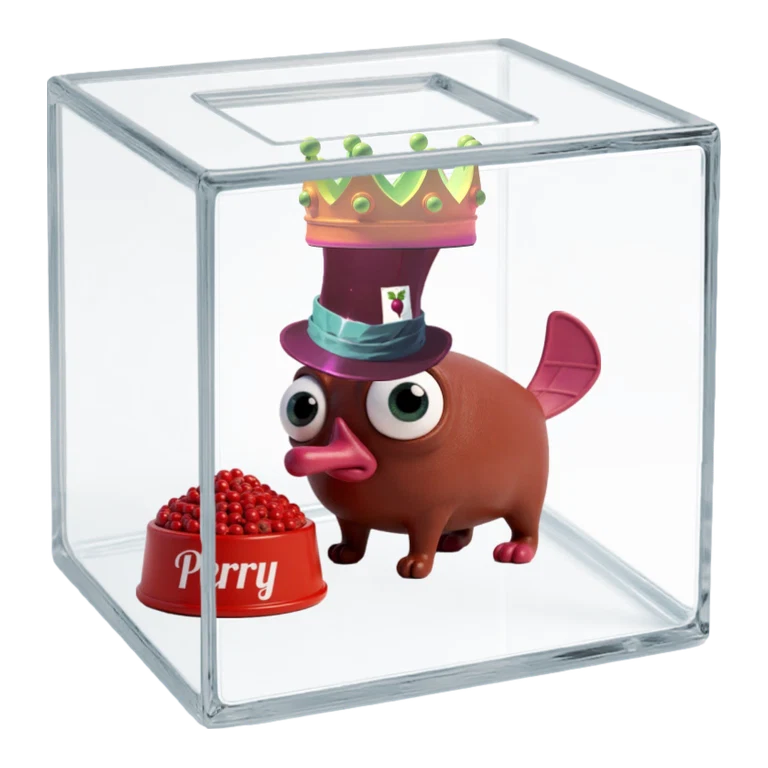
“Perry actin’…help to dine”
used off-label to stimulate appetite
In actin' like a docile pet, it helps to dine on pet food
“mad as a hatter” → BBB-crossing antimuscarinic
crown resembling H1 blocking peg → antihistamine
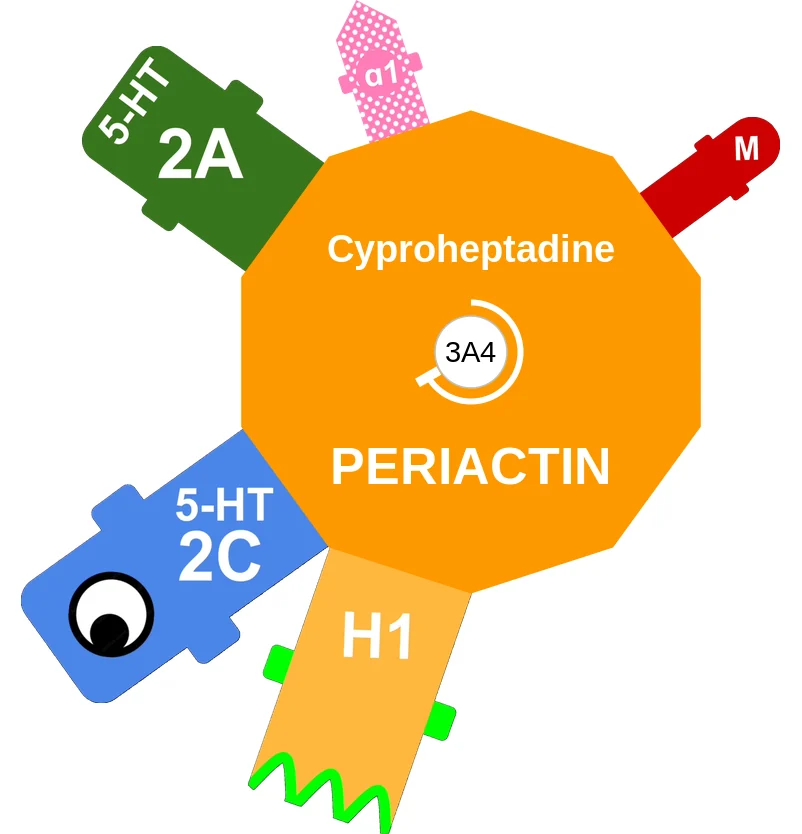
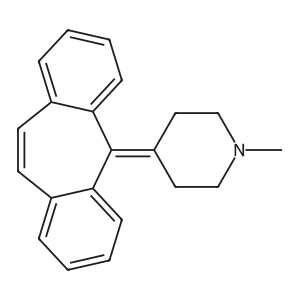
What it isFirst-generation antihistamine with 5-HT2 antagonism; allergy, appetite stimulation and serotonin syndrome.
Why this oneIt is the agent used for serotonin syndrome, and the appetite effect is exploited deliberately.
What limits itSedation and anticholinergic burden. Weight gain is the point or the problem, depending on the patient.
FDA-approved for
- allergy (~1961)
Off-label
- appetite stimulation
- serotonin syndrome
- SSRI sexual dysfunction
FDA label
Read the full label on DailyMed ↗
| FDA dosing | Population | Start | Target | Max |
|---|---|---|---|---|
| Allergic conditions (antihistamine) | Pediatrics 2–6 yr | 2 mg BID–TID | 12 mg/day | |
| Allergic conditions (antihistamine) | Pediatrics 7–14 yr | 4 mg BID–TID | 16 mg/day | |
| Allergic conditions (antihistamine) | Adults | 4 mg TID | 4–20 mg/day (typical 12–16 mg) | 0.5 mg/kg/day (~32 mg) |
Renal Undefined
Hepatic Undefined
Instructions
- Individualize dose to patient response
Available strengths
- tab 4 mg
- sol 2 mg/5 mL
Contraindications
- Newborn or premature infants
- Nursing mothers
- MAOIs (concurrently) because MAO inhibitors prolong and intensify the anticholinergic effects of antihistamines
- Angle-closure glaucoma
- Stenosing peptic ulcer
- Symptomatic prostatic hypertrophy
- Bladder neck obstruction
- Pyloroduodenal obstruction
- Elderly, debilitated patients
Adverse reactions
- Sedation, drowsiness, dizziness
- Dry mouth
- Increased appetite / weight gain
- Blurred vision
- Anticholinergic effects (urinary retention, constipation)
Pregnancy Category B — use only if clearly needed
Lactation Contraindicated in nursing mothers
Cost
Generic entry1982
NO BOXED WARNINGS
Principal riskSedation, anticholinergic burden and weight gain
Classes and tags
Clinical profile
Legacy pregnancy categoryB
Defining liabilityGenerally tolerated at therapeutic doses; clinically important risks are agent-specific and increase with interactions or organ impairment.
Serotonicity
This drug is routinely called serotonergic. By Gillman’s human-effect criteria it does not raise serotonin in the synapse.
5-HT2A antagonist used as an oral antidotal treatment for serotonin toxicity.
Label contraindicationMAOIs (concurrently) because MAO inhibitors prolong and intensify the anticholinergic effects of antihistamines. The label governs prescribing; Gillman’s point concerns serotonin toxicity only.
Gillman’s four human testsA measurable SERT affinity that fails all four is not clinical serotonicity.
- Retarded orgasm
- Efficacy in OCD and cataplexy
- Clonus and hyperreflexia in single-drug overdose
- Serotonin toxicity when combined with an MAOI
Non-elevating action5-HT2A antagonist
Evidence confidenceHigh
Background: what serotonicity is · what is and is not an SRI · what counts as a relevant MAOI.
Open Cyproheptadine in the interactive console ↗
Memory aids: interaction avatars