Cyclobenzaprine
FLEXERIL
Pronunciation: sye-kloe-BEN-za-preen
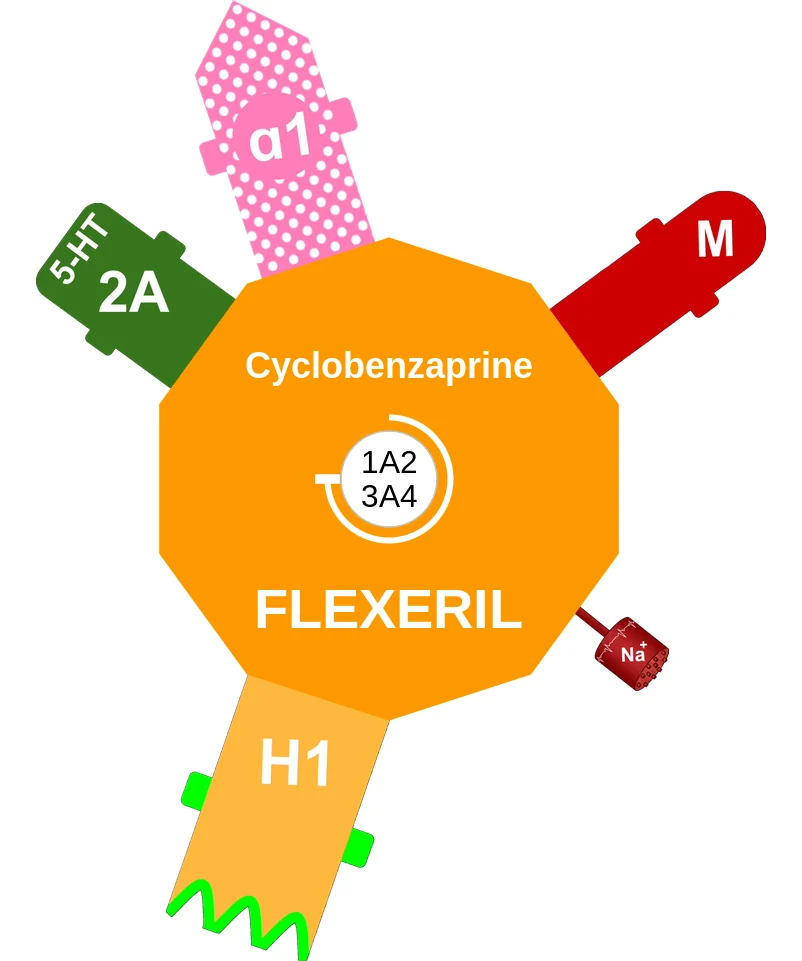

“Flexible Cycle bending”
What it isTricyclic-related central muscle relaxant with H1 and muscarinic antagonism; short-term treatment of acute muscle spasm.
Why this onePronounced sedation can make it useful when nighttime spasm dominates, unlike less sedating relaxants.
What limits itAnticholinergic effects, falls and next-day sedation limit it, especially in older adults. Avoid with MAOIs.
FDA-approved for
- muscle spasm (1977)
Off-label
- fibromyalgia
- insomnia
FDA label
Read the full label on DailyMed ↗
| FDA dosing | Population | Start | Target | Max |
|---|---|---|---|---|
| Muscle spasm, adjunct to rest/PT for acute musculoskeletal conditions | Adults | 5 mg TID | 5 mg TID | 10 mg TID |
Renal Undefined
Hepatic Use less frequent dosing in hepatic impairment
Instructions
- Do not use for periods longer than 2–3 weeks
- Use less frequent dosing in the elderly
Available strengths
- tab 5, 7.5, 10 mg
- ER cap 15, 30 mg
- ODT 2.8 mg
- SL tab 2.8 mg
Contraindications
- MAOIs (concurrently or within 14 days) due to risk of hyperpyretic crises, severe convulsions, and death
- Acute recovery phase of myocardial infarction
- Arrhythmias, heart block or conduction disturbances, or congestive heart failure
- Hyperthyroidism
Adverse reactions
- Drowsiness
- Dry mouth
- Fatigue
- Dizziness
- Headache
Pregnancy Undefined
Lactation Undefined
Cost
Generic entry1989
NO BOXED WARNINGS
Principal riskAnticholinergic burden and sedation
Classes and tags
Clinical profile
Legacy pregnancy categoryUnknown / historical label unavailable
Defining liabilityGenerally tolerated at therapeutic doses; clinically important risks are agent-specific and increase with interactions or organ impairment.
Serotonicity
This drug is routinely called serotonergic. By Gillman’s human-effect criteria it does not raise serotonin in the synapse.
Named as a serotonergic muscle relaxant in the opioid labels, but Gillman places it with the drugs unlikely to be dangerous with an MAOI, alongside amitriptyline. The label still contraindicates MAOIs (concurrently or within 14 days).
Gillman’s four human testsA measurable SERT affinity that fails all four is not clinical serotonicity.
- Retarded orgasm
- Efficacy in OCD and cataplexy
- Clonus and hyperreflexia in single-drug overdose
- Serotonin toxicity when combined with an MAOI
Non-elevating actionNone recorded
Evidence confidenceHigh
Background: what serotonicity is · what is and is not an SRI · what counts as a relevant MAOI.
Open Cyclobenzaprine in the interactive console ↗
Memory aids: interaction avatars