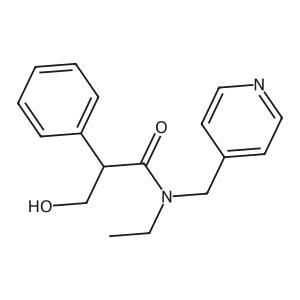
Tropicamide
MYDRIACYL
Pronunciation: troe-PIK-a-mide
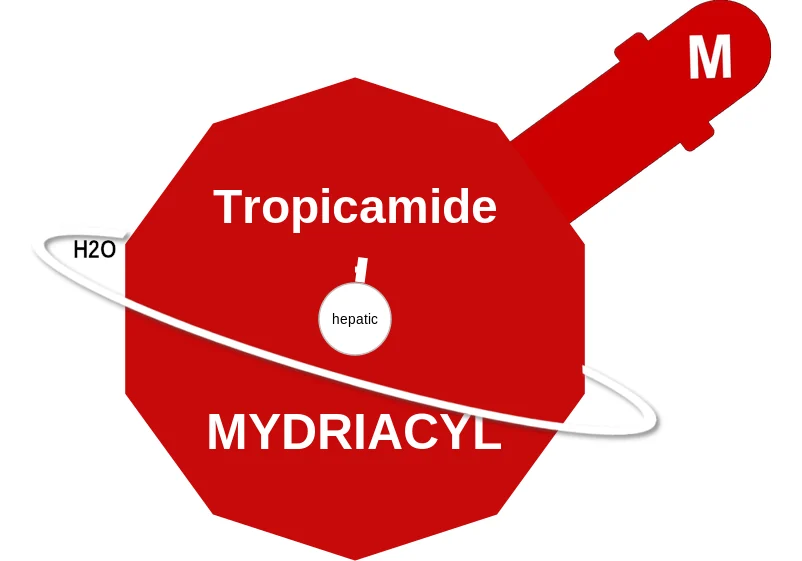
What it isShort-acting ophthalmic antimuscarinic that produces mydriasis and cycloplegia for eye examination.
Why this oneRapid onset and brief duration allow faster visual recovery than atropine or cyclopentolate.
What limits itMay transiently raise intraocular pressure and can cause systemic anticholinergic CNS effects, especially in children; punctal occlusion reduces absorption.
FDA-approved for
- mydriasis for eye exam (~1960)
FDA label
Read the full label on DailyMed ↗
| FDA dosing | Population | Start | Target | Max |
|---|---|---|---|---|
| Mydriasis/cycloplegia for refraction | Adults and pediatric | 1–2 drops 1% in eye(s), repeat in 5 min | 1–2 drops 1% | additional drop at 20–30 min to prolong effect |
Renal Undefined
Hepatic Undefined
Instructions
- Topical ophthalmic use only
- Heavily pigmented irides may require higher strength or more doses
- Mydriasis reverses spontaneously in 4–8 h (up to 24 h)
Available strengths
- drops 0.5, 1 %
Cautions
- May raise intraocular pressure; caution in narrow-angle glaucoma
- CNS/psychotic reactions and cardiorespiratory collapse reported in children (anticholinergic)
- Systemic anticholinergic effects
Adverse reactions
- Transient stinging, blurred vision, photophobia, punctate keratitis
- Increased intraocular pressure
- Dry mouth, tachycardia, headache, pallor, nausea/vomiting
- CNS disturbances, muscle rigidity, allergic reactions
Pregnancy Animal reproduction studies not conducted; use only if clearly needed
Lactation Undefined
Cost
| Strength | #/mo | generic $/unit | CostPlus | |
|---|---|---|---|---|
| 0.5 % | drops | per unit | not offered | |
| 1 % | drops | per unit | not offered |
Generic entry1982
NO BOXED WARNINGS
Principal riskprecipitation of acute angle-closure glaucoma
Classes and tags
Clinical profile
Legacy pregnancy categoryC
Defining liabilityLocal irritation, sensitization or administration-site injury; negligible systemic toxicity at usual use.