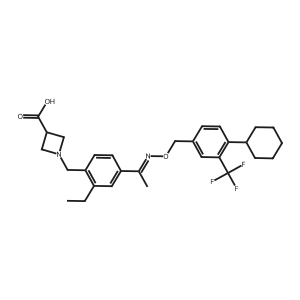
Siponimod
MAYZENT
Pronunciation: si-PON-i-mod (MAY-zent)
What it isS1P1/S1P5 modulator sequestering lymphocytes; active secondary-progressive multiple sclerosis.
Why this oneIt has direct disability-progression evidence in secondary-progressive disease, where options are limited.
What limits it⚑ CYP2C9*3/*3 is contraindicated—genotype before treatment. Initiation can cause bradycardia; monitor for macular edema and liver injury.
FDA label
Read the full label on DailyMed ↗
| FDA dosing | Population | Start | Target | Max |
|---|---|---|---|---|
| Multiple sclerosis, relapsing forms | Adults, CYP2C9 *1/*1, *1/*2, or *2/*2 | 0.25 mg QD Day 1 (5-day titration) | 2 mg QD from Day 6 | 2 mg QD |
| Multiple sclerosis, relapsing forms | Adults, CYP2C9 *1/*3 or *2/*3 | 0.25 mg QD Day 1 (4-day titration) | 1 mg QD from Day 5 | 1 mg QD |
Titration Mandatory initiation titration: Day 1 0.25 mg, Day 2 0.25 mg, Day 3 0.5 mg, Day 4 0.75 mg (then Day 5 1.25 mg for the 2-mg regimen); if any titration dose is missed >24 h, restart from Day 1
Renal Undefined
Hepatic No specific dose adjustment stated; obtain transaminases/bilirubin (within 6 months) before initiation and closely monitor patients with severe hepatic impairment
Interruption of ≥4 consecutive daily doses after initial titration → reinitiate from Day 1 titration, repeating first-dose monitoring where recommended
Instructions
- Before first dose: CYP2C9 genotype (required), ECG, recent CBC, LFTs, baseline fundus/macula exam, skin exam, VZV antibody test (vaccinate seronegative patients before starting), review immunosuppressant history
- Administer tablets whole; do not split, crush, or chew
- First-dose 6-hour monitoring (hourly pulse/BP, ECG at end) if sinus bradycardia (HR <55 bpm), first- or second-degree Mobitz I AV block, or history of MI or heart failure; extend monitoring for HR <45 bpm, nadir at 6 h, or new AV block
- Cardiologist consultation before use with QT-prolonging or heart-rate-slowing drugs or in preexisting cardiac/cerebrovascular disease
Available strengths
- tab 0.25, 1, 2 mg
Contraindications
- CYP2C9*3/*3 genotype (substantially elevated siponimod levels)
- In the last 6 months: MI, unstable angina, stroke, TIA, decompensated heart failure requiring hospitalization, or Class III/IV heart failure
- Mobitz type II second-degree or third-degree AV block, or sick sinus syndrome, unless a functioning pacemaker is present
Cautions
- Infections (herpes zoster/VZV meningoencephalitis, cryptococcal meningitis, fatal cases) — CBC before starting; delay start in active infection; vigilance continues 3–4 wk after stopping
- Progressive multifocal leukoencephalopathy — withhold at first sign/symptom
- Macular edema — baseline and periodic fundus exams; diabetes and uveitis increase risk
- Bradyarrhythmia/AV conduction delays — transient HR decrease at initiation; titration required; caution with beta-blockers and other HR-lowering drugs
- Decline in pulmonary function — spirometry if clinically indicated
- Liver injury — LFTs before initiation; discontinue if significant injury
- Cutaneous malignancies — baseline and periodic skin exams
- Increased blood pressure — monitor during treatment
- Fetal risk — effective contraception during and 10 days after stopping
- Posterior reversible encephalopathy syndrome
- Additive immunosuppression with prior/concomitant immune therapies
- Severe increase in disability after stopping; immune effects persist 3–4 weeks after discontinuation
Adverse reactions
- Most common (>10%): headache, hypertension, transaminase increases
- Also more common than placebo: herpes zoster/herpes infections, bradycardia at initiation, macular edema, lymphopenia (dose-dependent reduction to 20–30% of baseline)
Pregnancy Can cause fetal harm (embryotoxicity/teratogenicity in rats and rabbits at ≥2× human exposure); effective contraception during and 10 days after stopping; pregnancy safety study — report exposures to Novartis
Lactation No human data; rat milk excretion shown — weigh benefits of breastfeeding against risk to infant
Cost
| Strength | #/mo | generic $/mo | CostPlus | |
|---|---|---|---|---|
| 0.25 mg | tab | 30 qd | not offered | |
| 1 mg | tab | 30 qd | not offered | |
| 2 mg | tab | 30 qd | not offered |
NO BOXED WARNINGS
Principal riskCYP2C9*3/*3 is a contraindication — genotype first
Classes and tags
Clinical profile
Legacy pregnancy categoryN/A (post-2015 labeling)
Defining liabilityInitiation bradycardia, infection and multisystem monitoring