Prilocaine
CITANEST
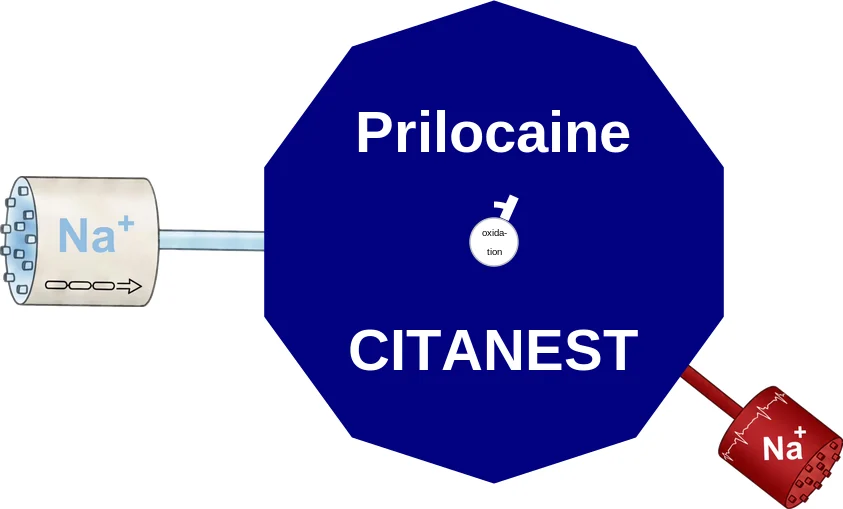
What it isAmide local anesthetic; dental and topical anesthesia, and part of EMLA.
Why this oneLess cardiotoxic than the other amides and effective in the eutectic topical mixture on intact skin.
What limits itIts metabolite causes methemoglobinemia, so it is avoided in infants and in G6PD deficiency.
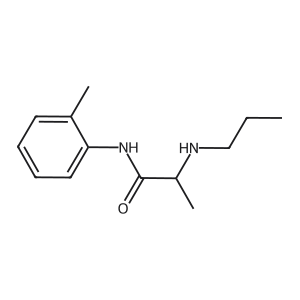
FDA-approved for
- local anesthesia (1965)
FDA label
Read the full label on DailyMed ↗
| FDA dosing | Population | Start | Target | Max |
|---|---|---|---|---|
| Dental local anesthesia (infiltration or nerve block) — 4% injection | Adult | 1-2 mL (40-80 mg) usually adequate per procedure | Least volume giving effective anesthesia | <70 kg: 8 mg/kg per 2-h period; >=70 kg: 600 mg (8 cartridges) per 2-h period |
| Dental local anesthesia — 4% injection | Children <10 yr | Rarely >1/2 cartridge (40 mg) per procedure (single tooth) | Per standard pediatric formula (e.g., Clark's rule; ~6.6-8.8 mg/kg in a 5-yr-old) |
Renal Undefined
Hepatic Use with caution in hepatic disease; severe hepatic disease increases risk of toxic plasma concentrations (no specific dose given)
Maximum doses are per two-hour period
Instructions
- Aspirate prior to injection to reduce intravascular injection risk
- Use lowest dose giving effective anesthesia; observe maximum dose per any 2-hour period
- Reduce doses in debilitated, elderly, acutely ill patients and children
- Plain solution suited to short maxillary procedures (<=15 min); discard unused cartridge portion
Available strengths
- inj 40 mg/mL
Contraindications
- Known history of hypersensitivity to amide-type local anesthetics
- Congenital or idiopathic methemoglobinemia
Cautions
- Methemoglobinemia — highest risk in G6PD deficiency, infants <6 months, cardiac/pulmonary compromise, and with other oxidizing agents; treat with methylene blue if severe
- Systemic toxicity (CNS excitation/depression, cardiovascular depression) from excessive dose or intravascular injection — resuscitative equipment must be immediately available
- Repeated doses accumulate; reduce dose in debilitated/elderly/acutely ill patients and children
- Caution in hepatic disease, severe shock, heart block, impaired cardiovascular function
- Head and neck injections may produce systemic-toxicity-like reactions — monitor circulation and respiration
- Have malignant hyperthermia management protocol available
Adverse reactions
- CNS: lightheadedness, nervousness, confusion, dizziness, drowsiness, tinnitus, blurred/double vision, tremors, convulsions, unconsciousness, respiratory depression/arrest
- CV: bradycardia, hypotension, cardiovascular collapse, cardiac arrest
- Methemoglobinemia (cyanosis; may be delayed hours)
- Swelling and persistent paresthesia of lips/oral tissues (rarely >1 year)
- Allergic: urticaria, edema, anaphylactoid reactions (extremely rare)
Pregnancy Category B — rat studies to 30x human dose showed no fetal harm; no adequate human studies; consider before use in early pregnancy.
Lactation Unknown whether excreted in human milk; exercise caution in nursing women.
Cost
| Strength | #/mo | generic $/unit | CostPlus | |
|---|---|---|---|---|
| 40 mg/mL | inj | per unit | not offered |
NO BOXED WARNINGS
Principal riskMethemoglobinemia from its metabolite
Classes and tags
Clinical profile
Legacy pregnancy categoryB
Defining liabilityMethemoglobinemia and systemic local-anesthetic toxicity