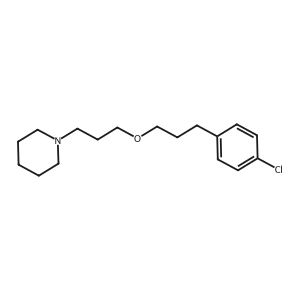
Pitolisant
WAKIX
Pronunciation: pi-TOL-i-sant
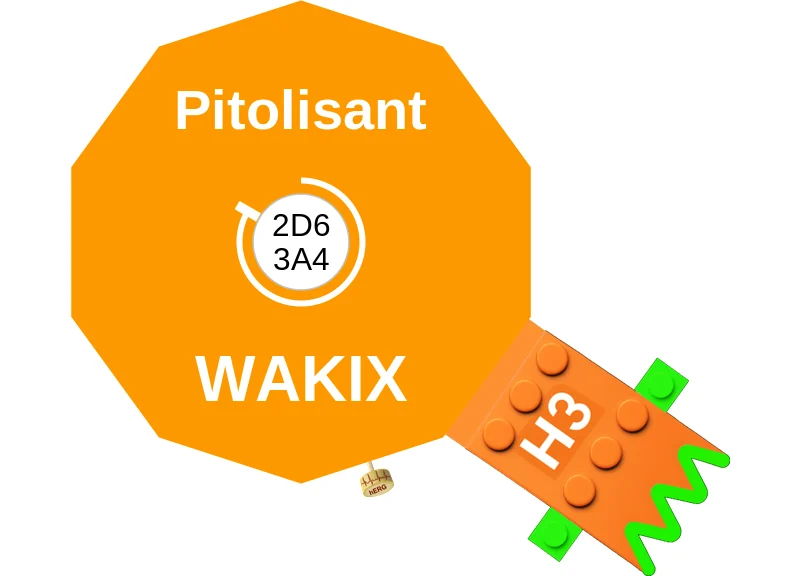

“Wacky Pitstop”
What it isHistamine H3 inverse agonist raising histamine release; narcolepsy.
Why this oneNon-scheduled and non-stimulant, which is unique among the wake-promoting agents.
What limits itQT prolongation. It reduces oral contraceptive efficacy; CYP2D6-dependent.
FDA-approved for
- narcolepsy (2019)
Off-label
- idiopathic hypersomnia
FDA label
Read the full label on DailyMed ↗
| FDA dosing | Population | Start | Target | Max |
|---|---|---|---|---|
| Narcolepsy — EDS or cataplexy | Adults | 8.9 mg QAM (Wk1) | 17.8 mg QAM (Wk2) | 35.6 mg QD |
| Narcolepsy — EDS or cataplexy | Peds ≥6 yr | 4.45 mg QAM (Wk1) | 8.9–17.8 mg QD | 17.8 mg QD (<40 kg) / 35.6 mg QD (≥40 kg) |
Titration Increase at weekly intervals (7 days for renal-impaired, 14 days for hepatic-impaired)
Renal eGFR <60: start 8.9 mg QD, max 17.8 mg QD (increase after 7 days); ESRD not recommended
Hepatic Moderate (Child-Pugh B): start 8.9 mg QD, max 17.8 mg QD after 14 days; severe impairment contraindicated
Instructions
- Take once daily in the morning upon wakening
Available strengths
- tab 4.45, 17.8 mg
Contraindications
- Severe hepatic impairment
Cautions
- QT-interval prolongation — avoid with QT-prolonging drugs and in patients with arrhythmia risk factors; monitor QTc in hepatic/renal impairment
Adverse reactions
- Insomnia
- Nausea
- Anxiety (adults)
- Headache, insomnia (peds ≥6 yr)
Pregnancy Pregnancy exposure registry; no established drug-associated risk; embryofetal toxicity in animals
Lactation Low transfer into breast milk (RID <1%); no data on breastfed infant
Cost
| Strength | #/mo | generic $/mo | CostPlus | |
|---|---|---|---|---|
| 4.45 mg | tab | 30 qd | not offered | |
| 17.8 mg | tab | 30 qd | not offered |
Generic entry2026
NO BOXED WARNINGS
Principal riskQT prolongation; it reduces contraceptive efficacy
Classes and tags
Clinical profile
Legacy pregnancy categoryNot assigned — PLLR-era drug
Defining liabilityQT prolongation and CYP-mediated interactions; insomnia and anxiety are common.
Open Pitolisant in the interactive console ↗