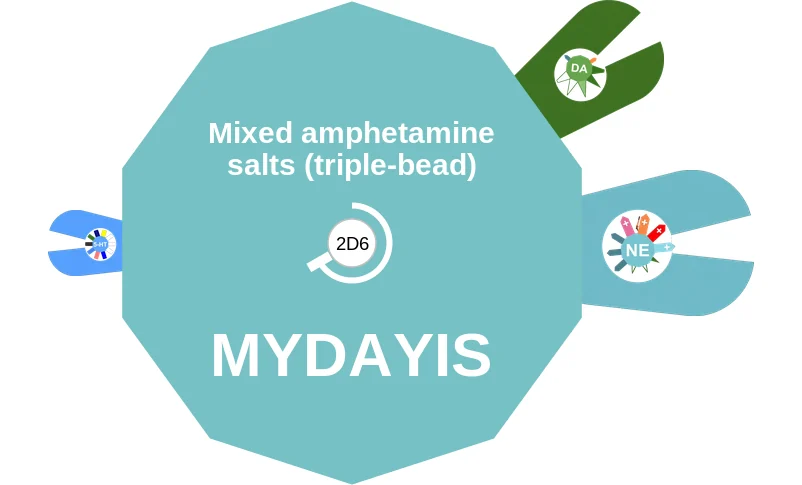
Mixed amphetamine salts (triple-bead)
MYDAYIS

“My (whole) day is amped”
The longest-acting amphetamine with a 16-hour duration of effect
What it isExtended-release mixed amphetamine salts that release norepinephrine, dopamine, and serotonin; ADHD, labeled for ages 13-17, adults.
Why this oneIts pH-dependent triple-release ER capsule provides 10-16 h (Carlat Table 1) of action, extending coverage later into the day.
What limits itAbuse, misuse, and addiction remain key hazards; late-day exposure can make insomnia hard to escape.
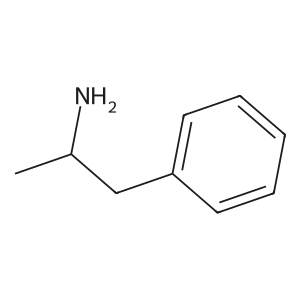
FDA-approved for
- ADHD (2017)
FDA label
Read the full label on DailyMed ↗
| FDA dosing | Population | Start | Target | Max |
|---|---|---|---|---|
| ADHD | Adults (18–55 y) | 12.5 mg QD upon awakening | individualized | 50 mg/day |
| ADHD | Peds 13–17 y | 12.5 mg QD upon awakening | individualized | 25 mg/day |
Titration May adjust in 12.5 mg increments no sooner than weekly
Renal Severe impairment (GFR 15–<30): adults max 25 mg/day, peds max 12.5 mg/day; not recommended in ESRD (<15)
Hepatic Undefined (not studied; hepatic dysfunction may prolong exposure)
Instructions
- Administer once daily in the morning upon awakening (effects may last up to 16 h)
- Take consistently with or without food
- Swallow whole or open capsule and sprinkle contents on applesauce, taken immediately without chewing
- Do not substitute for other amphetamine products on a mg-per-mg basis
- Allow 14 days after an MAOI
Available strengths
- ER cap 12.5, 25, 37.5, 50 mg
- cap 5, 10, 15, 20, 25, 30 mg
- tab 5, 7.5, 10, 12.5, 15, 20, 30 mg
Contraindications
- Concomitant treatment with monoamine oxidase inhibitors (MAOIs), or within 14 days of stopping MAOIs (including linezolid or intravenous methylene blue), because of an increased risk of hypertensive crisis
Cautions
- Risks to patients with serious cardiac disease — avoid in structural cardiac abnormalities
- Increased blood pressure and heart rate — monitor
- Psychiatric adverse reactions (mania, new psychotic/manic symptoms)
- Long-term growth suppression in pediatric patients
- Peripheral vasculopathy, including Raynaud's phenomenon
- Seizures — lowers convulsive threshold
- Serotonin syndrome with serotonergic drugs
- Motor and verbal tics, worsening of Tourette's syndrome
Adverse reactions
- Insomnia
- Decreased appetite
- Decreased weight
- Dry mouth
- Increased heart rate
- Anxiety
- Nausea (adolescents)
- Irritability (adolescents)
Pregnancy Limited data insufficient for risk; amphetamines cause vasoconstriction/decreased placental perfusion and may increase premature delivery/low birth weight; monitor neonate for withdrawal; registry available
Lactation Amphetamine present in human milk (relative infant dose 2–13.8%); breastfeeding not recommended during treatment
Cost
| Strength | #/mo | generic $/mo | CostPlus | |
|---|---|---|---|---|
| 12.5 mg | ER cap | 30 qd | $253.08 | not offered |
| 25 mg | ER cap | 30 qd | $14.68 | not offered |
| 37.5 mg | ER cap | 30 qd | $259.63 | not offered |
| 50 mg | ER cap | 30 qd | $243.22 | not offered |
Other forms: Amphetamine (ADDERALL) · Mixed amphetamine salts XR (ADDERALL XR)
⚠ BOXED WARNING
- Abuse, misuse and addiction
Classes and tags
Clinical profile
Serotonin and MAOI
Provisional washout figures
Elevating mechanismNone identified
Exposure dependenceNo serotonin-elevating mechanism identified
Evidence confidenceModerate
InterpretationNo clinically meaningful serotonin-elevating mechanism identified in this first-pass Gillman-based review.
Open Mixed amphetamine salts (triple-bead) in the interactive console ↗
Memory aids: interaction avatars
Open Mixed amphetamine salts (triple-bead) in the interactive console ↗