Methylnaltrexone
RELISTOR
Pronunciation: meth-il-nal-TREX-oen (REL-i-stor)
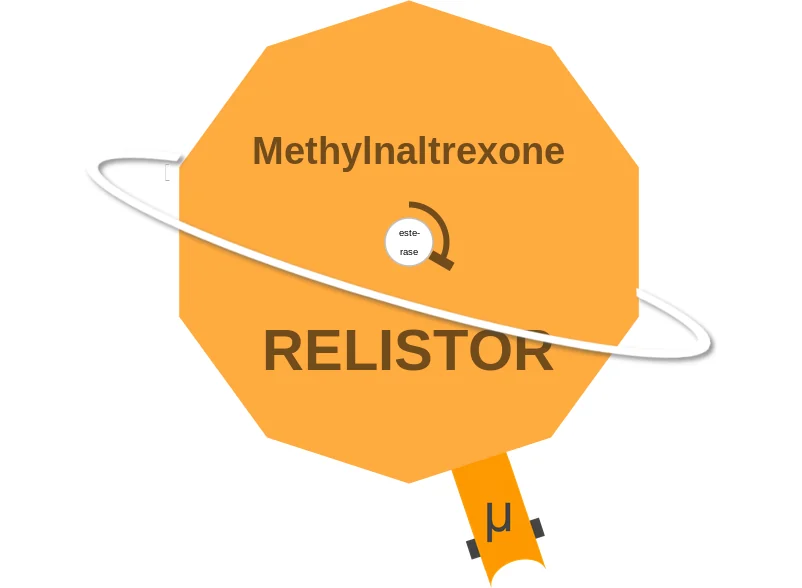
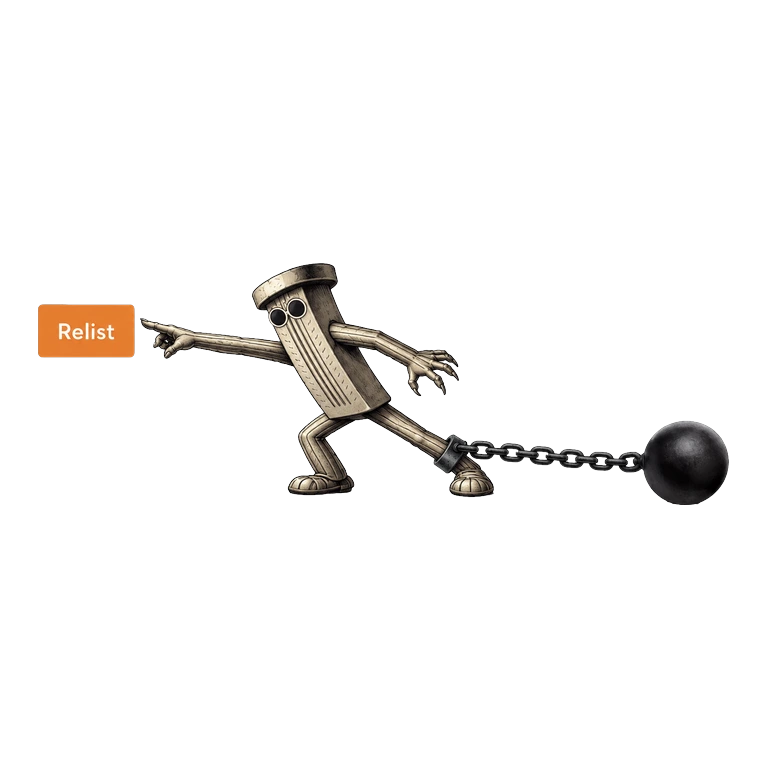
“Metal naltrexone, Relister”
“ball and chain → does not enter CNS
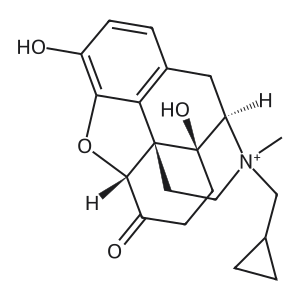
What it isPeripherally restricted mu antagonist; opioid-induced constipation.
Why this oneIt is the only PAMORA available by subcutaneous injection, allowing use when oral therapy is impractical.
What limits itGI perforation, so avoid in known or suspected obstruction. Renally adjusted.
FDA-approved for
- opioid-induced constipation (2008)
FDA label
Read the full label on DailyMed ↗
| FDA dosing | Population | Start | Target | Max |
|---|---|---|---|---|
| Opioid-induced constipation (OIC), chronic non-cancer pain — tablets | Adults | 450 mg PO QD in the morning | 450 mg QD | 450 mg QD |
| Opioid-induced constipation (OIC), chronic non-cancer pain — injection | Adults | 12 mg SC QD | 12 mg SC QD | 12 mg SC QD |
| Opioid-induced constipation (OIC), advanced illness — injection | Adults, weight-based | One dose SC every other day PRN | <38 kg: 0.15 mg/kg; 38–<62 kg: 8 mg; 62–114 kg: 12 mg; >114 kg: 0.15 mg/kg | 1 dose per 24 hours |
Renal CrCl <60 mL/min (moderate/severe, Cockcroft-Gault): tablets 150 mg QD AM; injection 6 mg SC QD (chronic non-cancer pain). Advanced illness injection QOD — <38 kg 0.075 mg/kg, 38–<62 kg 4 mg, 62–114 kg 6 mg, >114 kg 0.075 mg/kg. Mild impairment (CrCl >60): no adjustment needed.
Hepatic Tablets: Child-Pugh B or C, 150 mg QD AM; Child-Pugh A no adjustment needed. Injection: no adjustment needed for mild or moderate impairment; severe not studied — if adjusting, QOD at <38 kg 0.075 mg/kg, 38–<62 kg 4 mg, 62–114 kg 6 mg, >114 kg 0.075 mg/kg, and monitor.
Advanced illness: no more than one dose per 24-hour period. Every-other-day 12 mg SC dosing is NOT recommended for chronic non-cancer pain (higher rate of nausea, diarrhea, vomiting). Patients on opioids <4 weeks may be less responsive.
Instructions
- Be within close proximity to toilet facilities once administered.
- Chronic non-cancer pain: take tablets with water on an empty stomach at least 30 minutes before the first meal of the day.
- Discontinue all maintenance laxative therapy before starting; laxatives may be resumed as needed if response is suboptimal after 3 days.
- Discontinue if the opioid pain medication is discontinued; re-evaluate continued need whenever the opioid regimen changes.
- Discontinue for severe or persistent diarrhea.
- Injection is SC only — upper arm, abdomen, or thigh; rotate sites. Inspect for particulate/discoloration (normally colorless to pale yellow).
- Single-dose vials: once drawn up, store at ambient room temperature and administer within 24 hours; discard unused portion.
Available strengths
- tab 150 mg
- inj 8 mg/0.4 mL
- inj 12 mg/0.6 mL
Contraindications
- Known or suspected mechanical gastrointestinal obstruction, or increased risk of recurrent obstruction — risk of GI perforation
Cautions
- GI perforation reported where GI wall integrity may be reduced (peptic ulcer, Ogilvie's syndrome, diverticular disease, infiltrative GI malignancy, peritoneal metastases, Crohn's); monitor for severe, persistent, or worsening abdominal pain and discontinue if it develops.
- Severe or persistent diarrhea — discontinue.
- Opioid withdrawal (hyperhidrosis, chills, diarrhea, abdominal pain, anxiety, yawning); patients with a disrupted blood-brain barrier are at higher risk and may lose analgesia — monitor.
- Safety and effectiveness not established in pediatric patients; juvenile rats showed convulsions, tremors, labored breathing.
- Elderly: no dosage adjustment by age, but higher incidence of diarrhea with tablets — monitor.
Adverse reactions
- Tablets, chronic non-cancer pain (≥2%): abdominal pain, diarrhea, headache, abdominal distention, vomiting, hyperhidrosis, anxiety, muscle spasms, rhinorrhea, chills
- Injection, chronic non-cancer pain (≥1%): abdominal pain, nausea, diarrhea, hyperhidrosis, hot flush, tremor, chills
- Injection, advanced illness (≥5%): abdominal pain, flatulence, nausea, dizziness, diarrhea
- Serious: GI perforation; severe/persistent diarrhea; opioid withdrawal
- Postmarketing: cramping, vomiting, diaphoresis, flushing, malaise, pain
Pregnancy Limited human data; may precipitate opioid withdrawal in the fetus (immature fetal blood-brain barrier). No embryofetal effects in rats/rabbits.
Lactation Breastfeeding not recommended during treatment — risk of opioid withdrawal in the breastfed infant; present in rat milk.
Cost
| Strength | #/mo | generic $ | CostPlus | |
|---|---|---|---|---|
| 150 mg | tab | 30 qd | not offered | |
| 8 mg/0.4 mL | inj | per unit | not offered | |
| 12 mg/0.6 mL | inj | per unit | not offered |
Generic entry2025
NO BOXED WARNINGS
Principal riskGI perforation in advanced illness
Classes and tags
Clinical profile
Legacy pregnancy categoryC
Defining liabilityDiarrhea, dehydration and electrolyte disturbance, especially with excessive or prolonged use.
Open Methylnaltrexone in the interactive console ↗
Memory aids: interaction avatars