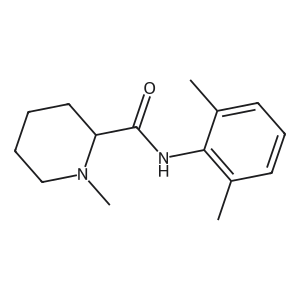
Mepivacaine
CARBOCAINE
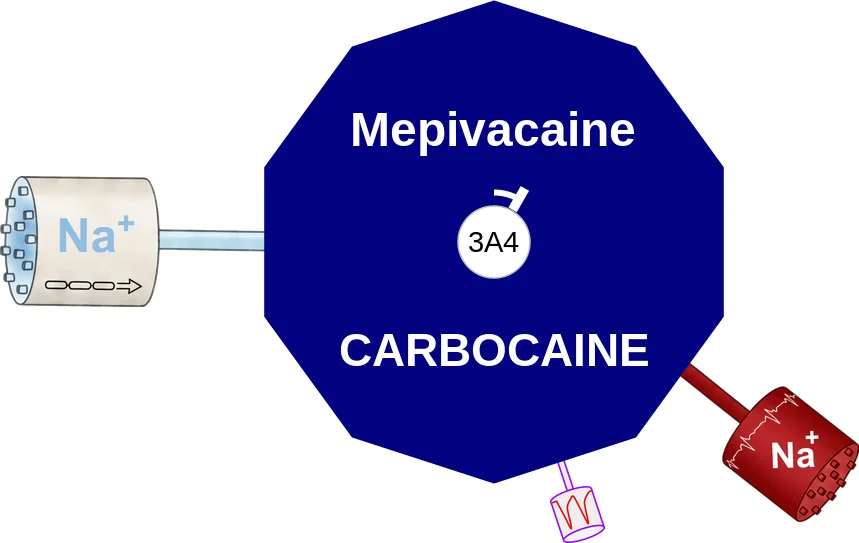
What it isAmide sodium-channel-blocking local anesthetic; dental and regional anesthesia.
Why this oneLess vasodilation than lidocaine lets it provide useful dental anesthesia without epinephrine.
What limits itIts duration is shorter than bupivacaine’s; neonatal toxicity makes it unsuitable for obstetric anesthesia.
FDA-approved for
- local/regional anesthesia (1960)
FDA label
Read the full label on DailyMed ↗
| FDA dosing | Population | Start | Target | Max |
|---|---|---|---|---|
| Dental infiltration / nerve block anesthesia | Adults | 1 cartridge (1.7 mL = 34 mg of 2% or 51 mg of 3%) PRN per site | 5.3 cartridges (180 mg of 2% or 270 mg of 3%) anesthetizes entire oral cavity | 3 mg/lb body weight; total ≤400 mg per dental sitting (all sites combined) |
| Dental infiltration / nerve block anesthesia | Pediatric | 1 cartridge (1.7 mL) PRN per site | Weight-based: 3 mg/lb (e.g. 40 lb = 120 mg; 60 lb = 180 mg) | Child's weight (lb) × 400 mg ÷ 150; and ≤5.3 cartridges per sitting (≤270 mg of 3%, ≤180 mg of 2%) |
Renal Undefined
Hepatic Undefined
Total for ALL injected sites at a single dental sitting must not exceed 400 mg in adults.
Instructions
- Use the lowest dose producing effective anesthesia; dose varies with site, tissue vascularity, individual tolerance, and technique.
- Inject slowly with frequent aspiration.
- Inspect for particulate matter and discoloration before use; discard any unused portion of a cartridge.
- Calculate maximum dose by weight whenever a larger dose seems needed for an extensive procedure; pediatric maximum must be carefully calculated.
Available strengths
- inj 10, 15, 20, 30 mg/mL
Contraindications
- Known hypersensitivity to amide-type local anesthetics
Cautions
- Systemic CNS/cardiovascular toxicity from high plasma levels — excessive dose, rapid absorption, inadvertent intravascular injection, or slow metabolism.
- Persistent paresthesia of lip/tongue/oral tissues reported, chiefly after mandibular nerve blocks (trigeminal nerve and branches), with slow, incomplete, or no recovery.
- Vasovagal reaction is common in dental practice, especially seated patients — watch for sweating, faintness, pulse or sensorium change; place recumbent and give oxygen.
- Great care with concentrations and doses in pedodontic administration.
Adverse reactions
- CNS excitation then depression: nervousness, dizziness, blurred vision, tremors → drowsiness, convulsions, unconsciousness, respiratory arrest
- Cardiovascular depression
- Persistent oral paresthesia (lips, tongue)
- Allergic reactions (rare): delayed cutaneous lesions, urticaria, edema; anaphylactoid reactions rarely
- Localized puffiness and swelling
Pregnancy Category C — animal reproduction studies not conducted; use only if clearly needed.
Lactation Unknown whether excreted in human milk; use with caution in nursing women.
Cost
| Strength | #/mo | generic $/unit | CostPlus | |
|---|---|---|---|---|
| 10 mg/mL | inj | per unit | not offered | |
| 15 mg/mL | inj | per unit | not offered | |
| 20 mg/mL | inj | per unit | not offered | |
| 30 mg/mL | inj | per unit | not offered |
NO BOXED WARNINGS
Principal riskAvoided in obstetric anesthesia
Classes and tags
Clinical profile
Defining liabilitySystemic local-anesthetic seizures and cardiovascular collapse