Mecamylamine
INVERSINE
What it isGanglionic nicotinic antagonist; historical antihypertensive, studied in smoking cessation.
Why this oneIt is one of the few centrally acting nicotinic antagonists, which is why it was revisited for addiction.
What limits itBlocking both autonomic limbs causes constipation, retention and orthostasis. Largely obsolete.
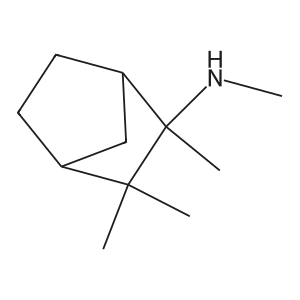
FDA-approved for
- hypertension (historical) (1956)
FDA label
Read the full label on DailyMed ↗
| FDA dosing | Population | Start | Target | Max |
|---|---|---|---|---|
| Hypertension (moderately severe to severe essential; uncomplicated malignant) | Adult | 2.5 mg BID | ~25 mg/day in ~3 divided doses |
Titration Increase by 2.5 mg increments at intervals of not less than 2 days until desired response.
Renal Contraindicated in uremia; give with great discretion, if at all, when renal insufficiency is manifested by rising/elevated BUN.
Hepatic Undefined
Instructions
- Give after meals for more gradual absorption; keep timing relative to meals consistent.
- Give the larger dose at noon (and perhaps evening); morning dose small or omitted.
- Reduce dose of concomitant antihypertensives to avoid excessive hypotension (continue thiazides at usual dose).
Available strengths
- tab 2.5 mg
Contraindications
- Mild, moderate, or labile hypertension; uncooperative patients.
- Coronary insufficiency or recent myocardial infarction.
- Uremia.
- Concurrent antibiotics or sulfonamides (with ganglion blockers).
- Glaucoma; organic pyloric stenosis.
Cautions
- Orthostatic/postural hypotension and syncope.
- Paralytic ileus (may be preceded by small, frequent liquid stools).
- CNS effects: convulsions, tremor, choreiform movements, mental aberrations, paresthesias.
Adverse reactions
- ileus/constipation
- nausea, vomiting, anorexia
- orthostatic dizziness/syncope, postural hypotension
- dry mouth, glossitis
- urinary retention, impotence, decreased libido
- blurred vision, dilated pupils
- weakness, fatigue, sedation
Pregnancy Pregnancy Category C; use only if clearly needed.
Lactation Undefined
Cost
| Strength | #/mo | generic $/mo | CostPlus | |
|---|---|---|---|---|
| 2.5 mg | tab | 60 BID | not offered |
NO BOXED WARNINGS
Principal riskBlocking both autonomic limbs causes constipation, retention and orthostasis
Classes and tags
Clinical profile
Legacy pregnancy categoryC
Defining liabilitySevere orthostatic hypotension, ileus and CNS toxicity