Lamotrigine XR
LAMICTAL XR
Pronunciation: la-MOE-tri-jeen (la-MIK-tal)
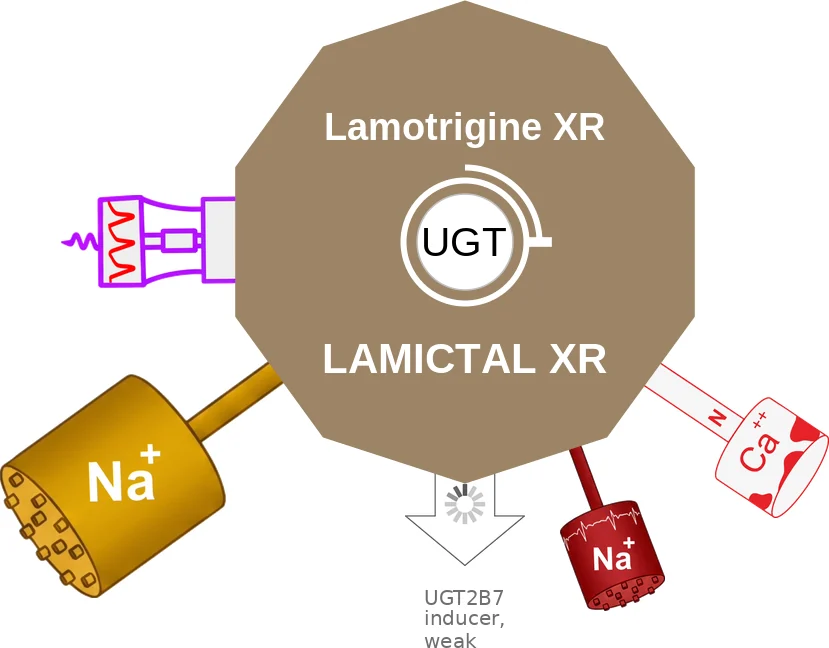

“Ictal Lamb”
“ictal” refers to seizure
What it isExtended-release antiepileptic modulating sodium, calcium, and HCN channels; adjunctive or monotherapy for seizures.
Why this oneIt is once daily for epilepsy; the bipolar-maintenance indication stays on IR.
What limits itRapid escalation or valproate coadministration raises serious-rash risk; stop promptly for a suspicious eruption.
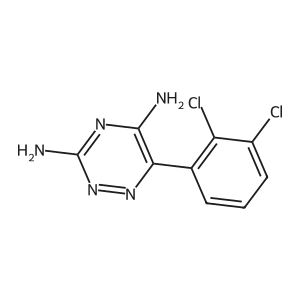
FDA-approved for
- seizures (adjunct/monotherapy) (2009)
FDA label
Read the full label on DailyMed ↗
| FDA dosing | Population | Start | Target | Max |
|---|---|---|---|---|
| Adjunctive therapy for primary generalized tonic-clonic and partial-onset seizures | Patients 13 yr and older | Depends on concomitant AED (e.g., 25 mg QOD with valproate; 25 mg QD if not on valproate/inducers; 50 mg QD with inducers) | 200-600 mg QD depending on concomitant AEDs | 600 mg QD |
| Conversion to monotherapy (partial-onset seizures, on a single AED) | Patients 13 yr and older | Per Table 1 escalation | 250-300 mg QD | 300 mg QD (monotherapy) |
Titration Slow weekly titration per concomitant-AED-specific schedule; do not exceed recommended initial dose or escalation
Renal Reduced maintenance doses may be effective in significant renal impairment; use with caution in severe renal impairment
Hepatic No adjustment in mild; reduce initial/escalation/maintenance ~25% in moderate-severe without ascites and ~50% in severe with ascites
Instructions
- Swallow tablets whole; do not chew, crush, or divide
- May take with or without food, once daily
- Discontinuation: taper over at least 2 weeks (~50% dose reduction per week)
- Do not restart in patients who discontinued due to rash unless benefits outweigh risks
- Adjust maintenance dose when starting/stopping estrogen-containing products
Available strengths
- ER tab 25, 50, 100, 200, 250, 300 mg
- tab 2, 5, 25, 50, 100, 150, 200, 250 mg
- ODT 25, 50, 100, 200 mg
- chew tab 5, 25 mg
- susp 10 mg/mL
Contraindications
- Hypersensitivity (e.g., rash, angioedema, acute urticaria, extensive pruritus, mucosal ulceration) to the drug or its ingredients
Cautions
- Life-threatening serious rash / rash-related death
- Hemophagocytic lymphohistiocytosis (HLH)
- Multiorgan hypersensitivity (DRESS) and organ failure
- Cardiac rhythm and conduction abnormalities (Class IB antiarrhythmic activity)
- Blood dyscrasias
- Suicidal behavior and ideation
- Aseptic meningitis
- Medication errors due to product name confusion
- Withdrawal seizures with abrupt discontinuation
Adverse reactions
- Dizziness
- Tremor/intention tremor
- Vomiting
- Diplopia
- Nausea
- Somnolence
Pregnancy Registry data have not detected an increased frequency of major malformations overall; lamotrigine levels may fall during pregnancy requiring dose adjustment. NAAED pregnancy registry available.
Lactation Lamotrigine present in human milk; infants at risk of high serum levels - monitor for rash, apnea, drowsiness, poor sucking/weight gain.
Cost
⚠ BOXED WARNING
- Serious skin rashes including Stevens-Johnson syndrome
Classes and tags
Clinical profile
Legacy pregnancy categoryC
Defining liabilitySerious rash risk is concentrated during rapid titration or re-titration; dizziness and diplopia are common.
Open Lamotrigine XR in the interactive console ↗
Memory aids: interaction avatars