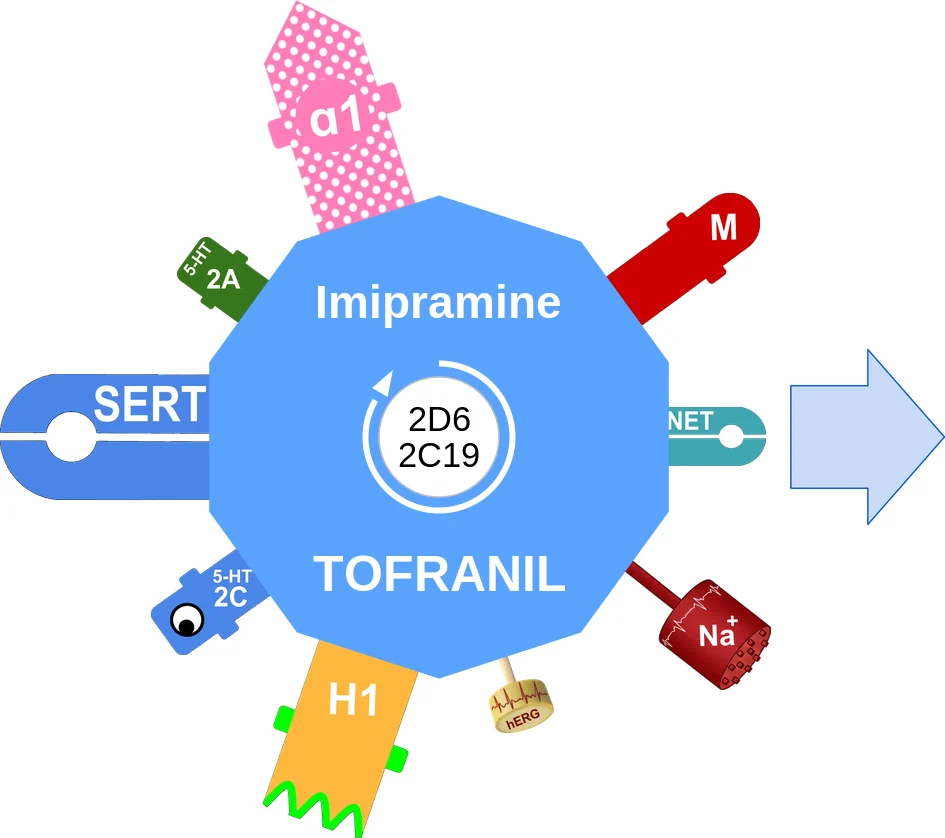
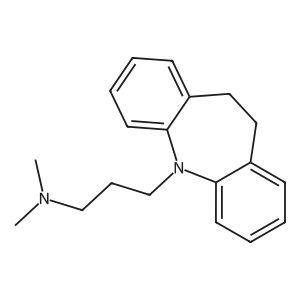
Imipramine
TOFRANIL
Pronunciation: im-IP-ra-meen (toe-FRAY-nil)
“I’m Toffee!”
oldest tricycle → oldest tricyclic antidepressant (TCA)
What it isTertiary-amine tricyclic blocking serotonin and norepinephrine reuptake; depression and panic disorder.
Why this oneIts established use for childhood nocturnal enuresis distinguishes it from most other antidepressants, despite safer alternatives.
What limits itAnticholinergic and orthostatic effects limit use, and sodium-channel blockade makes overdose potentially fatal.
FDA-approved for
- depression (1959)
- childhood enuresis (~1973)
Off-label
- panic disorder
FDA label
Read the full label on DailyMed ↗
| FDA dosing | Population | Start | Target | Max |
|---|---|---|---|---|
| Depression — hospitalized | Adults | 100 mg/day in divided doses | 200 mg/day | 250–300 mg/day (if no response after two weeks) |
| Depression — outpatients | Adults | 75 mg/day | 150 mg/day | 200 mg/day |
| Depression — maintenance | Adults | Lowest dose that maintains remission | 50–150 mg/day | Undefined |
| Depression | Geriatric | 30–40 mg/day | Up to 100 mg/day | Generally ≤100 mg/day |
| Depression | Adolescents | 30–40 mg/day | Up to 100 mg/day | Generally ≤100 mg/day |
| Childhood enuresis (temporary adjunct) | Children ≥6 y | 25 mg QHS | <12 y: 50 mg QHS; >12 y: up to 75 mg QHS | 75 mg/day; ≤2.5 mg/kg/day |
Titration Depression (hospitalized): two weeks before increasing to 250–300 mg/day; enuresis: one week before increasing
Renal Undefined
Hepatic Undefined
Lower doses for elderly, adolescents, and outpatients. Antidepressant effect may take one to three weeks. Prescribe smallest quantity consistent with good management (overdose risk).
Instructions
- Hospitalized depression: give in divided doses
- Enuresis: give one hour before bedtime; early-night bedwetters may do better with 25 mg midafternoon + 25 mg at bedtime
- Taper gradually rather than stopping abruptly
- Switching from an MAOI: allow at least 14 days, then start low and increase cautiously
Available strengths
- tab 10, 25, 50 mg
Contraindications
- Concomitant MAOIs (hyperpyretic crises, severe convulsive seizures); allow ≥14 days when switching
- Acute recovery period after myocardial infarction
Cautions
- Clinical worsening and suicide risk
- Screening for bipolar disorder
- Hyponatremia (SIADH)
- Angle-closure glaucoma
- Children: do not exceed 2.5 mg/kg/day (ECG changes)
- Cardiovascular disease — conduction defects, arrhythmias, CHF, MI, stroke
- Urinary retention / narrow-angle glaucoma (anticholinergic)
- Hyperthyroidism or thyroid medication
- Seizure disorder (lowers seizure threshold)
- Interactions: guanethidine/clonidine blockade; methylphenidate; alcohol
- Impaired ability to drive/operate machinery
Adverse reactions
- Orthostatic hypotension
- Tachycardia, arrhythmias, ECG changes
- Confusional states (esp. elderly)
- Anxiety, insomnia, nightmares
- Tremor, ataxia
- Seizures
- Dry mouth
- Blurred vision
- Constipation
- Urinary retention
- Drowsiness, dizziness
- Weight gain or loss
Pregnancy No controlled human studies; congenital malformations reported (causality not established) — use only if clinical condition clearly justifies fetal risk.
Lactation Likely excreted in breast milk; label advises against nursing.
Cost
Generic entry2010
⚠ BOXED WARNING
- Suicidal thoughts and behaviors in patients under 25
Classes and tags
Clinical profile
Legacy pregnancy categoryC
Defining liabilityAnticholinergic effects and cardiac sodium-channel blockade make overdose rapidly life-threatening.
Serotonin and MAOI
Provisional washout figures
Elevating mechanismWeak/borderline SRI
Non-elevating actionNone recorded
Exposure dependenceDose/exposure dependent; clinical relevance mainly with MAO-A inhibition
Washout BEFORE an MAOI14 days
Evidence confidenceModerate
InterpretationBorderline/on-the-cusp SRI; potentially serious with an MAOI, especially at high exposure.
Active metabolites
Open Imipramine in the interactive console ↗