Fluocinonide
LIDEX
Pronunciation: floo-oe-SIN-oe-nide
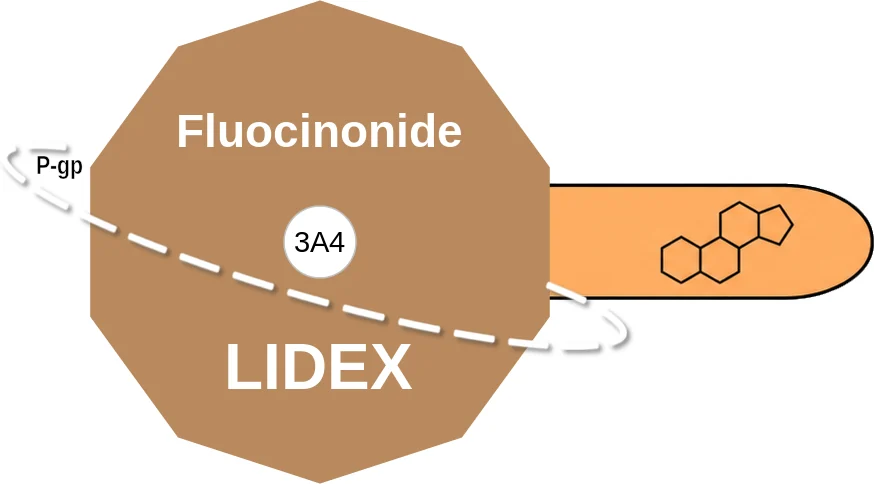
What it isHigh-potency topical glucocorticoid-receptor agonist; corticosteroid-responsive dermatoses.
Why this oneStrong enough for thick plaques while remaining below the superpotent class, so it suits intermediate disease.
What limits itSkin atrophy and striae with continued use. Off the face and flexures; limit to two weeks at a time.
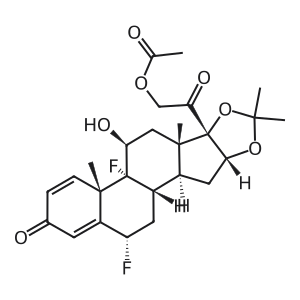
FDA-approved for
- corticosteroid-responsive dermatoses
FDA label
Read the full label on DailyMed ↗
| FDA dosing | Population | Start | Target | Max |
|---|---|---|---|---|
| Corticosteroid-responsive dermatoses | Topical | Thin film 2–4×/day | Thin film 2–4×/day | Thin film 2–4×/day |
Renal Undefined
Hepatic Undefined
Instructions
- Apply a thin film to the affected area 2–4 times daily
- Occlusive dressings may be used for psoriasis/recalcitrant conditions; discontinue occlusion and treat if infection develops
Available strengths
- sol 0.05 %
- cream 0.05, 0.1 %
- ointment 0.05 %
- gel 0.05 %
Cautions
- HPA-axis suppression, esp. with occlusion, large surface area, or prolonged use
- Local reactions and skin atrophy
- Secondary infection
Adverse reactions
- Burning
- Itching
- Irritation
- Dryness
- Folliculitis
- Perioral dermatitis
- Allergic contact dermatitis
- Skin atrophy
- Striae
Pregnancy Use only if potential benefit justifies risk; avoid extensive use, large amounts, or prolonged periods.
Lactation Undefined
Cost
| Strength | #/mo | generic $/unit | CostPlus | |
|---|---|---|---|---|
| 0.05 % | sol | per unit | not offered | |
| 0.05 % | cream | per unit | not offered | |
| 0.1 % | cream | per unit | not offered | |
| 0.05 % | ointment | per unit | not offered |
Generic entry1987
NO BOXED WARNINGS
Principal riskSkin atrophy with continued use
Classes and tags
Clinical profile
Legacy pregnancy categoryC
Defining liabilityLocal tissue effects and irritation; systemic corticosteroid toxicity is uncommon at usual exposure.