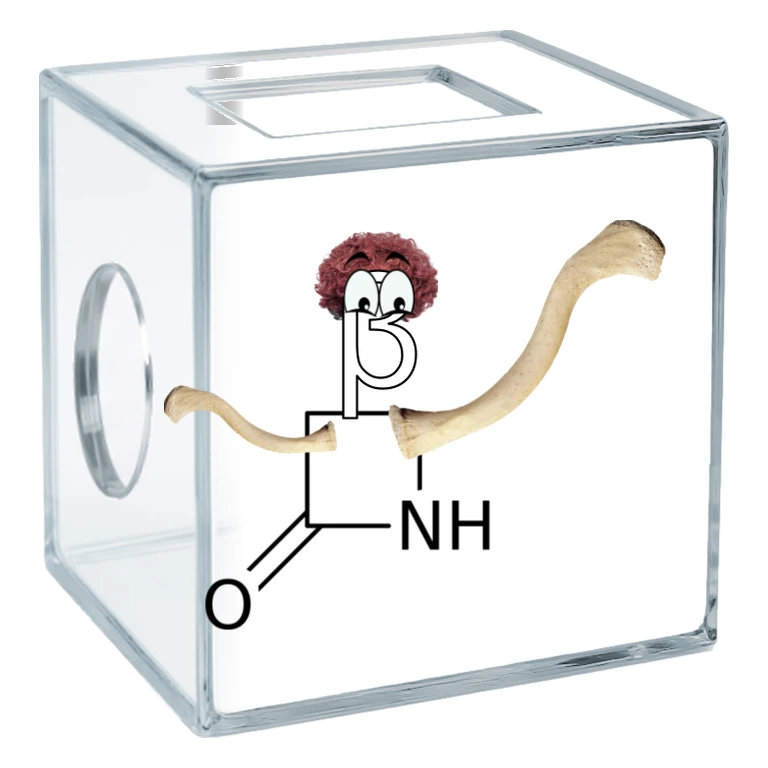
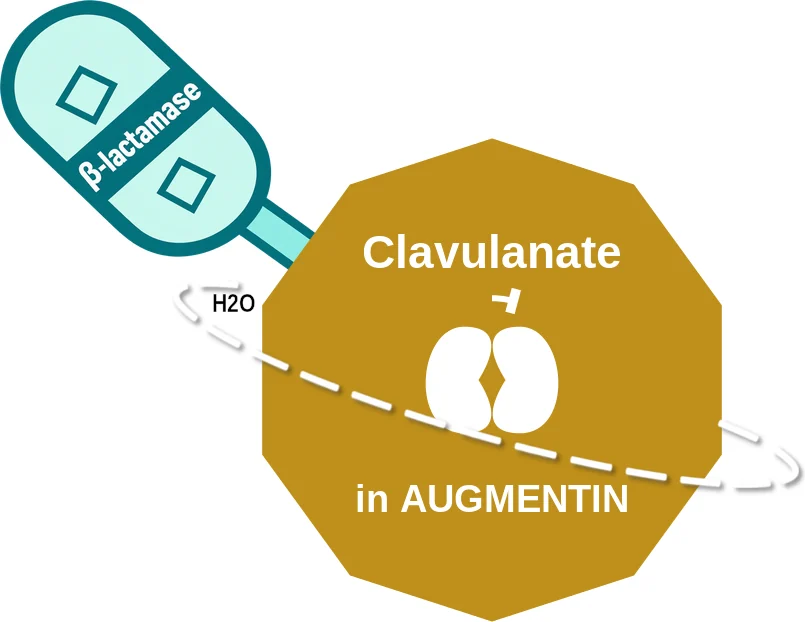
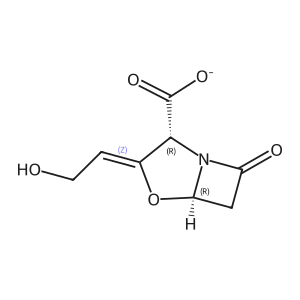
Clavulanate
in AUGMENTIN

“Clavicle Annie”
What it isBeta-lactamase inhibitor with no useful antibacterial activity of its own; given with amoxicillin.
Why this oneIt restores amoxicillin against beta-lactamase producers, which is the whole reason the combination exists.
What limits itDiarrhea is dose-limiting and comes from the clavulanate, not the amoxicillin — so choose the formulation with the lower clavulanate share.
FDA label
Read the full label on DailyMed ↗
| FDA dosing | Population | Start | Target | Max |
|---|---|---|---|---|
| Severe infections and respiratory tract infections | Adult / peds ≥40 kg | 875 mg q12h (BID) or 500 mg q8h (TID) | ||
| Less severe infections | Adult / peds ≥40 kg | 500 mg q12h (BID) or 250 mg q8h (TID) | ||
| Otitis media, sinusitis, LRTI, more severe infections | Peds ≥12 wk, <40 kg | 45 mg/kg/day q12h (BID) or 40 mg/kg/day q8h (TID) | adult dose | |
| Less severe infections | Peds ≥12 wk, <40 kg | 25 mg/kg/day q12h (BID) or 20 mg/kg/day q8h (TID) | ||
| General | Neonate/infant <12 wk | 30 mg/kg/day divided q12h (BID) |
Renal GFR 10-30 mL/min: 500 or 250 mg q12h; GFR <10 mL/min: 500 or 250 mg q24h; hemodialysis: 500 or 250 mg q24h plus a dose during and at end of dialysis. Do not use the 875 mg dose if GFR <30 mL/min.
Hepatic Undefined
Instructions
- Take at the start of a meal to enhance clavulanate absorption and minimize GI upset
- Do not substitute two 250 mg/125 mg tablets for one 500 mg/125 mg tablet
- 250 mg/125 mg tablet not for children weighing <40 kg (different amoxicillin:clavulanate ratio)
Available strengths
- tab 250/125, 500/125, 875/125 mg
- ER tab 1/62.5 g
- chew tab 200/28.5, 400/57 mg
- susp 125/31.25, 200/28.5, 250/62.5, 400/57, 600/42.9 mg/5 mL
Contraindications
- History of serious hypersensitivity (anaphylaxis, Stevens-Johnson syndrome) to other beta-lactams (penicillins, cephalosporins)
- Prior cholestatic jaundice/hepatic dysfunction associated with amoxicillin/clavulanate
Cautions
- Serious and occasionally fatal hypersensitivity reactions
- Severe cutaneous adverse reactions (SJS, TEN, DRESS, AGEP)
- Drug-induced enterocolitis syndrome (DIES)
- Hepatic dysfunction and cholestatic jaundice (monitor LFTs)
- C. difficile-associated diarrhea
- Erythematous rash in patients with mononucleosis (avoid use)
- Microbial overgrowth/superinfection
Adverse reactions
- Diarrhea/loose stools
- Nausea
- Skin rash and urticaria
- Vomiting
- Vaginitis
Pregnancy Pregnancy Category B; no evidence of fetal harm in animal reproduction studies; use only if clearly needed.
Lactation Amoxicillin is excreted in human milk and may sensitize infants; use with caution in nursing mothers.
Cost
NO BOXED WARNINGS
Principal riskDiarrhea, the dose-limiting component of amoxicillin-clavulanate
Classes and tags
Clinical profile
Open Clavulanate in the interactive console ↗
Memory aids: interaction avatars