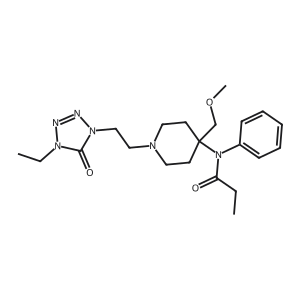
Alfentanil
ALFENTA
Pronunciation: al-FEN-ta-nil
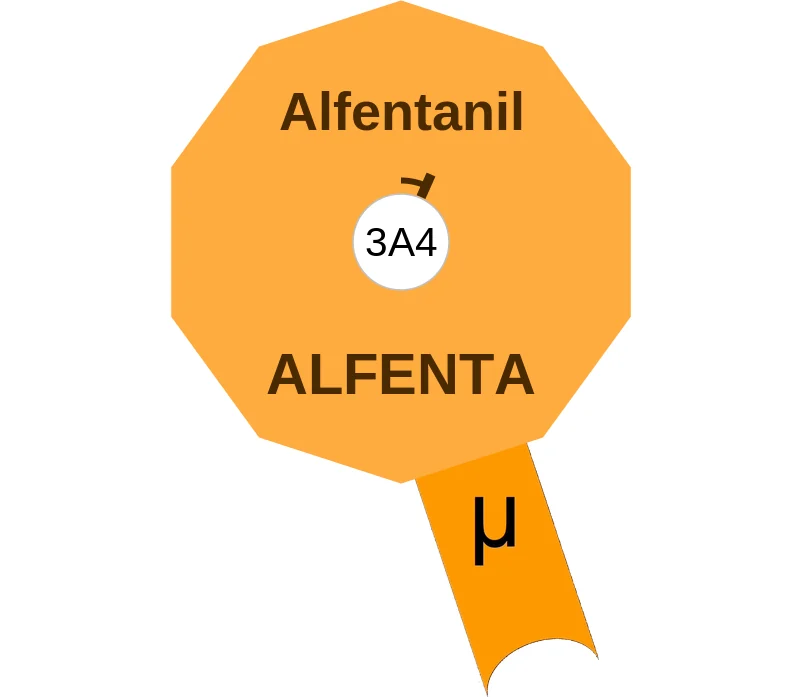

“Al, fountain eel”
opioids constrict pupils
What it isShort-acting mu-opioid agonist; anesthesia.
Why this oneA large unionized fraction at physiologic pH gives faster onset than fentanyl, while brief action suits short procedures.
What limits itRapid bolus can cause chest-wall rigidity. Respiratory depression and CYP3A4 interactions matter.
FDA-approved for
- anesthesia (1986)
FDA label
Read the full label on DailyMed ↗
| FDA dosing | Population | Start | Target | Max |
|---|---|---|---|---|
| Analgesic adjunct — spontaneous/assisted ventilation | Adults | Induction 8-20 mcg/kg; maintenance 3-5 mcg/kg q5-20min or 0.5-1 mcg/kg/min | Total 8-40 mcg/kg | |
| Analgesic adjunct — assisted/controlled ventilation (incremental) | Adults | Induction 20-50 mcg/kg; maintenance 5-15 mcg/kg q5-20min | Up to 75 mcg/kg | |
| Anesthetic induction | Adults | Induction 130-245 mcg/kg; maintenance 0.5-1.5 mcg/kg/min | ||
| Monitored anesthesia care (MAC) | Adults | Induction 3-8 mcg/kg; maintenance 3-5 mcg/kg q5-20min or 0.25-1 mcg/kg/min | 3-40 mcg/kg |
Renal Undefined
Hepatic Undefined
Instructions
- Individualize and titrate to effect; base dose on lean body weight in obese patients (>20% above ideal weight)
- Reduce dose in elderly or debilitated patients
- Anesthetic induction doses: expect truncal rigidity — use a muscle relaxant; administer slowly over 3 minutes
- Discontinue infusion at least 10-15 minutes before end of surgery
- Not recommended in children under 12 years
Available strengths
- inj 0.5 mg/mL
Contraindications
- Known intolerance to other opioid agonists
Cautions
- Respiratory depression — ensure qualified personnel and resuscitation facilities
- Skeletal muscle (truncal) rigidity
- Bradycardia and hypotension
Adverse reactions
- Nausea (28%), vomiting (18%), chest wall rigidity (17%)
- Hypertension (18%), bradycardia (14%), tachycardia (12%), hypotension (10%)
- Apnea/postoperative respiratory depression
Pregnancy Pregnancy Category C. Embryocidal in animals at high/prolonged doses; use only if potential benefit justifies risk.
Lactation Undefined
Cost
Alfentanil (ALFENTA)
| Strength | #/mo | generic $/unit | CostPlus | |
|---|---|---|---|---|
| 0.5 mg/mL | inj | per unit | not offered |
NADAC is a voluntary CMS survey of what retail community pharmacies pay for the drugs they stock. Alfentanil is administered under clinical supervision and dispensed outside retail pharmacies, so it rarely appears on surveyed invoices.
⚠ BOXED WARNINGS
- Addiction, abuse and misuse
- Life-threatening respiratory depression
- Risk from concomitant use with benzodiazepines
Principal riskRigidity with rapid bolus